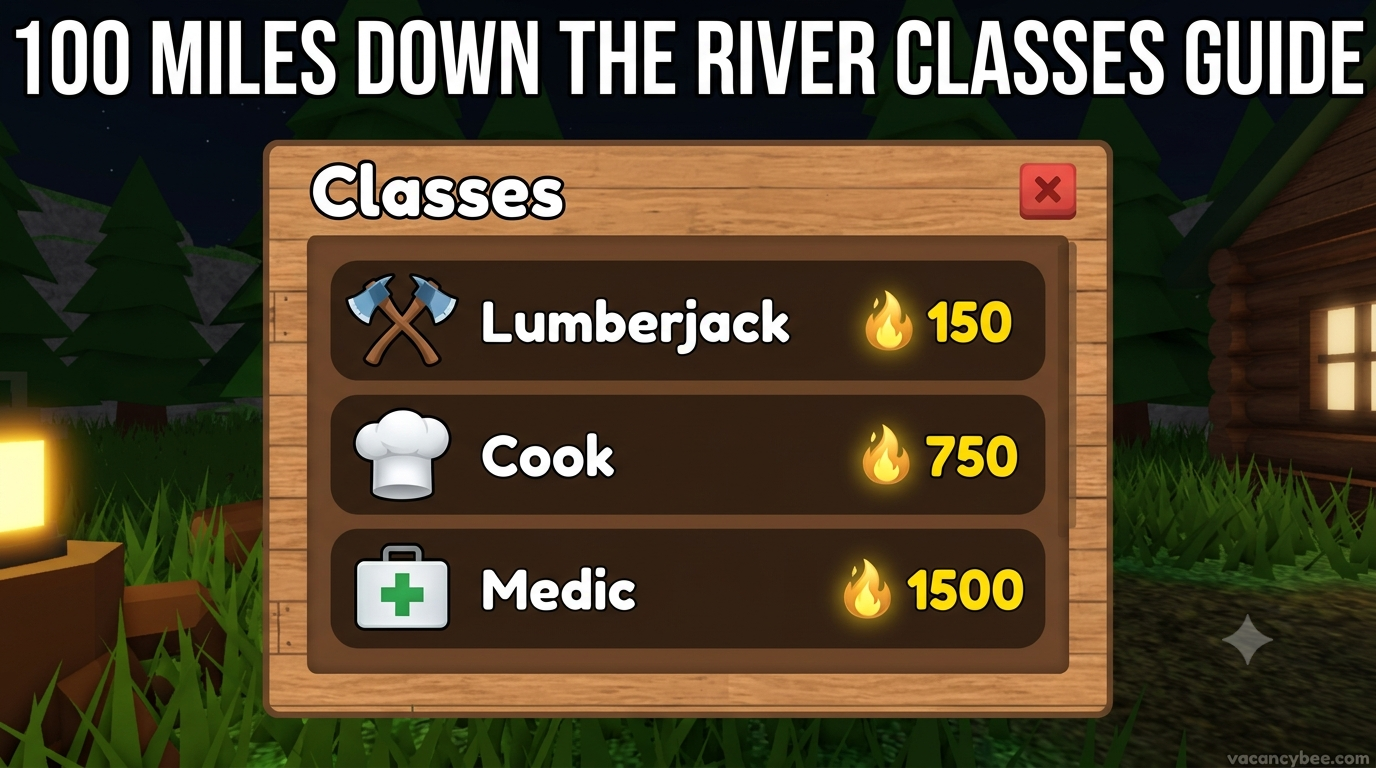
There are currently three classes in 100 Miles Down the River: Lumberjack, Cook, and Medic, costing 150, 750, and 1,500 Embers respectively. Each class gives you a starter item plus a permanent passive buff: Lumberjack collects one extra wood per chop, Cook makes food restore 15% more hunger, and Medic revives teammates 15% faster. Classes are bought with Embers at the lobby’s Classes shop and level up through star upgrades as you play. I’ve tested all three across solo and squad runs, and this guide covers every price, perk, upgrade requirement, the smartest purchase order, and the fastest ways to farm Embers in December 2026.
| Class | Price | Starter Item | Perk | Best For |
|---|---|---|---|---|
| Lumberjack | 150 Embers | Axe | +1 wood per chop | Beginners, solo |
| Cook | 750 Embers | Cooked Fish | Food restores 15% more hunger | Solo hunger control |
| Medic | 1,500 Embers | Bandage | Revives teammates 15% faster | Squads |
All Classes in 100 Miles Down the River
Every class stays useful for an entire run, so the right pick depends on whether you travel alone or with a crew.
Lumberjack (150 Embers)
The Lumberjack starts with an Axe and collects one additional wood per chop, which stacks up fast when you’re building your raft, repairing hull damage, and keeping campfires burning. Every star level increases chopping speed, and stars are earned by chopping a set amount of wood — something you’re doing anyway. This is the cheapest class in the game, and since wood powers every survival system on the river, I consider it the best value per Ember. My favorite part is that it levels passively: you hit star milestones without ever changing how you play. Everyone on the raft punches trees for logs eventually — Lumberjack just makes every swing count for one more.
Cook (750 Embers)
The Cook spawns with a Cooked Fish and makes all food restore 15% more hunger, with each star pushing that number higher. Upgrades come from cooking a set number of meals. Hunger is the quiet run-killer in this game — starvation slowly drains your health, and fishing trips pull you away from paddling downstream. I run Cook on solo sessions because every meal stretches further, which means fewer stops and more miles covered before dark. The free cooked fish also gives you instant food security the moment a run starts, instead of scrambling to catch your first meal. The 15% bonus means fewer fishing detours too, and every detour you skip is distance gained before nightfall.
Medic (1,500 Embers)
The Medic carries a Bandage and revives teammates 15% faster, scaling further with every star earned through healing or reviving. It’s the most expensive class and the only one built entirely around squad play — the perk does nothing when you’re alone, because there’s nobody to pick up. In a crew, though, one faster revive can save a run when the Stormwalker or river hazards knock a teammate down far from camp. Buy it once you have a regular group, and ideally let your most experienced player run it so revives happen in the safest spots. Its stars climb naturally there as well, because healing and reviving teammates is exactly what team play demands.
How to Buy Classes in 100 Miles Down the River?
Buying classes takes under a minute once you know where the shop hides:
- Launch 100 Miles Down the River and load into the lobby.
- Head to the right side of spawn, next to the leaderboard.
- Find the Classes shop and walk up to the class you want.
- Select it and confirm the purchase with your Embers.
- Equip it before starting your next run.
Two things I wish I’d known earlier: star upgrades can’t be bought with Embers — you earn them by performing the class’s core task (chopping, cooking, healing), though Robux can skip the grind if you’re impatient. And you’re never locked into one build: buying, equipping, swapping, and checking star progress all happen in that same lobby menu, free of charge.
Which Class Should You Buy First?
My purchase order is Lumberjack → Cook → Medic, matching both price and usefulness. Lumberjack’s 150 Ember price makes it an easy first buy, and the extra wood directly supports the three systems that end runs early: raft building, repairs, and campfires. Cook comes second once your Ember income stabilizes, because solo hunger management becomes the main bottleneck around the halfway mark.
Medic is last, and it only makes sense with a team. Owning all three costs 2,400 Embers total, and in squad play the strongest setup is one player per class so every buff stays active. Groups also fund purchases faster: crews that survive longer bank more badges and milestones per run than a solo player grinding alone. If Roblox survival games are new to you, my Huss Valley Beginner’s Guide breaks down another asymmetric mode worth trying after your first 100-mile run.
How to Get Embers Fast in 2026?
Embers come from completing runs, earning badges, and collecting Journal Notes and Pages, with distance milestones paying steady rewards as you push past the 10–25 mile range most beginners hit on early attempts. Badges are the real engine — there are 13 to unlock, each paying out Embers, and finishing all 36 Journal Notes plus 9 Journal Pages earns the Full Journal Badge. Even the finish line pays: completing the full run awards the Mile 100 badge, and finishing solo adds Lone Paddler.
The fastest early boost is codes. As of December 2026, two active codes give free rewards: RIVER100 for 100 Embers — two-thirds of the Lumberjack’s price, free — and STARLIGHT for the Starlight Otter Pet. Click the Codes button on the right side of the screen, type the code exactly, and hit REDEEM. Codes rotate without warning, so redeem them today. I verify freebies across other Roblox games too — my Escape the Cave Codes and Roblox Rocket Rush Codes pages are refreshed whenever developers drop new codes.
Pro Tips for Getting More From Each Class
- Stockpile wood before boarding. Campfires burn through logs fast at night, and Lumberjack’s surplus keeps you from scrambling in the dark.
- Fish and cook in bulk during daylight. As Cook, prepping meals before dark beats cooking while the Stormwalker closes in.
- Search every campsite. Journal Pages and loot spawn at stops, and they’re the same rewards that fund your next class.
- Repair between camps. A patched raft travels farther, stretching every run — and every Ember payout.
FAQs
What is the best class in 100 Miles Down the River?
Lumberjack is the best class for most players. It’s the cheapest at 150 Embers, and wood supports raft construction, repairs, and campfires — the three systems that decide whether your run survives the night.
How much do all classes cost in 100 Miles Down the River?
All three classes cost a combined 2,400 Embers: 150 for Lumberjack, 750 for Cook, and 1,500 for Medic. Badges, completed runs, and codes like RIVER100 cover that total within roughly a week of regular play.
Can you buy class star upgrades with Embers?
No. Star upgrades are earned by performing each class’s core activity — chopping wood, cooking meals, or reviving teammates. Robux can skip the grind, but Embers only unlock the class itself.
Is the Medic class worth it for solo players?
No. Medic’s faster revive speed only affects teammates, so the perk sits unused in solo runs. Solo players get more value from Lumberjack or Cook, which boost resource gathering and hunger control.

Related Articles