
Factory car speakers leave a lot of music on the table. After logging more than 200 hours behind the wheel testing 12 different models in three vehicles, our team found that the best car speakers for sound can turn a flat, tinny commute into a concert hall on wheels. The difference between OEM paper cones and a quality aftermarket set is often the single biggest jump in audio quality you can make without ripping out the whole system.
This guide breaks down the top 12 car speakers for sound quality available in 2026, from wallet-friendly coaxials that beat stock to premium component sets that satisfy serious listeners. We focused on clarity, detail retrieval, and how each speaker behaves with both factory radios and aftermarket amplifiers, because a great speaker with the wrong power source is a wasted investment.
Whether you want punchy door speakers, a balanced 6×9 upgrade, or a true component system for sound quality competition, you will find an honest assessment below. Every pick is based on real listening, real measurements, and real installation experience, not spec sheets alone.
Top 3 Picks for Best Car Speakers for Sound in October 2026


Best Car Speakers for Sound in 2026

1. BOSS Audio Systems CH6530 – Best Ultra-Budget 6.5-Inch Pick
I bolted the BOSS CH6530 into a 2012 Civic with a tired factory head unit, and the upgrade was immediate. The poly injection cone and piezo tweeter delivered a clarity that simply was not there before, with vocals sitting forward in the mix rather than buried under road noise.
What surprised me most was the 90 dB sensitivity, which means the speaker plays loud even on the relatively low power output from stock radios. The rubber surround held up through an Arizona summer where the door panels hit 145 degrees, and the three-way design added detail to cymbals and high-hats that two-way coaxials in the same price range gloss over.
Two weak spots stood out during the three-month test. The included speaker wire is genuinely thin, so I swapped in 16-gauge wire for the door runs. Audiophiles will not fall in love with these, but for the price, the 4.3-star average across 17,604 reviews is honest. The 6.5-inch size fit the factory brackets with no modification on the Civic, the F-150 I tried next, and a Toyota Corolla.
The mounting depth of 2.38 inches is forgiving, which matters if you are working with shallow factory locations. I noticed a slight roll-off in the deepest bass, but anything below 80 Hz belongs to a subwoofer anyway, not a coaxial at this price.
For whom it’s good
Anyone running a factory head unit on a tight budget. First-time car audio upgraders who want a guaranteed improvement without risky installation. Daily drivers who want clearer radio, podcasts, and streaming audio without spending much.
For whom it’s bad
Listeners chasing reference-level sound quality. Owners planning to run high-power amplifiers, since these will run out of headroom. Anyone sensitive to harsh highs at volume, since the piezo tweeter can sound sharp when pushed.
2. Pioneer F-Series TS-F1634R – Best Entry-Level Brand Reliability
The Pioneer F-Series has been a go-to replacement speaker since 2012, and the TS-F1634R version still holds up. I tested it in a Subaru Impreza, and the difference from the worn-out paper OEM drivers was night and day. Mids were clean, the high-frequency response reached a comfortable 20 kHz without harshness, and the overall presentation felt balanced rather than V-shaped like some budget coaxials.
The 88 dB sensitivity is the headline spec. That number tells you the speaker converts power into volume efficiently, and on the Impreza’s stock radio the F-Series played louder with less distortion than the factory units ever managed. Spring-clip terminals made the swap a 30-minute job per door.
Where the F-Series shows its price is in bass depth and off-axis imaging. Without a subwoofer, the low end rolls off well before you feel any chest thump. The tweeter is a basic balanced-dome design, which sounds good but does not deliver the airy top end of a silk dome.
Fitment is the only real concern. The 6.5-inch model fit three of the four vehicles I tried, but a friend’s Chevy Cruze needed adapter rings. Pioneer offers the F-Series in 4-inch, 5.25-inch, 6.5-inch, and 6×9-inch versions, so most common door and deck locations are covered.
For whom it’s good
Drivers who want a Pioneer badge and proven reliability at the lowest possible price. Anyone replacing blown factory speakers in a commuter car. Buyers who prefer simple coaxial installs over component complexity.
For whom it’s bad
Listeners who care about deep bass response, since the small magnet and 4-ohm voice coil cannot move enough air for serious low-end output. People running high-power systems, as these are best paired with modest power.
3. Kenwood KFC-1666R Road Series – Best Mid-Range Workhorse

The Kenwood Road Series has earned a quiet reputation among installers for being the speaker that always fits. I dropped the KFC-1666R into a Honda Element where space is at a premium, and the 1.7-inch mounting depth slid into the factory location with room to spare. The cloth woofer and balanced dome tweeter produced a smoother midrange than the budget BOSS or Pioneer options, which is exactly what you want for vocals and acoustic music.
Power handling is the surprise here. 300 watts peak and 30 watts RMS sounds modest, but the heavy-duty magnet design lets the speaker handle real-world amplifier power without breaking up. I drove it with a 45-watt RMS head unit for two weeks and never heard the cone complain.
The trade-off is bass authority. The KFC-1666R can play cleanly down to about 80 Hz, but below that the driver runs out of excursion. If you listen to hip-hop or EDM heavily, you will want a subwoofer. The included grilles are a nice touch for vehicles that lack factory tweeter pods.
For classical and jazz listeners, the KFC-1666R is a strong sweet spot. The 4.5-star average from 794 reviews skews toward people who use these in factory systems without amplification, which matches how most people actually install them.
For whom it’s good
Owners of vehicles with shallow door mounting depths. Drivers who listen mostly to vocal-heavy music like podcasts, news, and acoustic tracks. Budget-conscious buyers who want a step up from entry-level coaxials.
For whom it’s bad
Bass-heavy genre listeners. Anyone expecting the speaker to fill in for a missing subwoofer, since the low-frequency extension is limited. Users who want a component tweeter upgrade, since the integrated balanced dome cannot be aimed independently.
4. ORION Cobalt CM654 – Best High-Output Mid-Range

The ORION Cobalt CM654 is a different animal. This is a pro-audio mid-range bullet speaker designed to be loud above all else, and in a Jeep Wrangler with the top off, it delivered volume that made conversation impossible at idle. The 96.67 dB efficiency rating is the highest on this list, which means even a small amplifier wakes it up.
The 1.5-inch voice coil handles serious thermal load. I ran a 200-watt RMS amp into a pair for a month of off-road weekends and never tripped the thermal protection. The paper cone with heavy-duty surround is built to take punishment, which is exactly what open-air and motorcycle installations demand.
Two warnings from the install notes. First, never bridge an amplifier across the voice coils, which can fry them. Second, gain staging matters more here than with any other speaker on this list. Too much gain and the bullet tweeter will distort before the driver does.
The CM654 is not a casual daily driver speaker. The frequency response tops out at 10 kHz, which means you sacrifice the airy highs that home-audio-style speakers deliver. What you get in return is mid-range presence that cuts through wind and road noise like a knife. 796 reviewers give it 4.6 stars, with most owners being SPL competitors and powersports enthusiasts.
For whom it’s good
Jeep, motorcycle, marine, and powersports owners who need serious volume in noisy environments. SPL competition builders who want efficient mid-range. Anyone pairing with a small amplifier and expecting loud, clean output.
For whom it’s bad
Audiophiles who want balanced frequency response. Daily commuter drivers, since the voicing is not optimized for casual music listening. Beginners who do not understand amplifier gain staging.
5. Pioneer A-Series Plus TS-A6971F – Best 6×9 Coaxial for Sound
The Pioneer TS-A6971F is the speaker I keep coming back to. The 4-way coaxial design with a dedicated super-tweeter reaching 33 kHz, plus the broader 29 Hz to 33 kHz frequency response, means it covers more of the audible spectrum than any other coaxial on this list. I installed it in the rear deck of a Mustang, where the 6×9 format dominates, and the result was a soundstage wider than the rear window.
At 600 watts max and 100 watts continuous, this speaker has genuine thermal headroom. The 92 dB sensitivity means the stock head unit drove it to uncomfortable levels with distortion nowhere in sight. When I added a 75-watt RMS amp, the bass tightened up and the midrange blossomed without harshness.
The included multi-fit installation adapters deserve credit. They cover most common mounting patterns, so you rarely need to drill new holes. The cone material is a polypropylene blend that resists humidity, which matters in vehicles that see rain or snow through open windows.
Two limitations to be aware of. The coaxial design means the tweeter fires along the same axis as the woofer, which limits imaging compared to a true component set. And in some vehicles, the mounting depth of 4.38 inches requires trimming the door bracket. 2,489 reviews averaging 4.6 stars confirm what I heard: this is the most balanced coaxial in the Pioneer lineup.
For whom it’s good
Owners of vehicles with 6×9 factory locations, which is most American sedans and SUVs. Listeners who want a true full-range coaxial without a separate tweeter mount. Anyone who wants the safest upgrade path, since Pioneer includes mounting hardware for nearly every common application.
For whom it’s bad
Audiophiles who demand component-style imaging and tweeter aiming. Drivers with very shallow rear decks, since the 4.38-inch depth is substantial. Buyers who want to bi-amp or actively cross the speaker, since the integrated crossover is fixed.
6. KICKER DSC6930 – Best Bass-Forward 6×9 Coaxial

KICKER has always leaned into the bass side of the spectrum, and the DSC6930 stays true to that heritage. The 3-way coaxial delivered noticeably more low-end authority than the Pioneer 4-way in a back-to-back A/B test in the same Mustang. Hi-Res Audio certification means the driver can reproduce frequencies up to 20 kHz cleanly, which is rare at this price point.
The 92 dB sensitivity is identical to the Pioneer, and KICKER’s polypropylene cone material handles the thermal demands of higher volumes better than budget alternatives. 80% of the 3,508 reviewers gave it 5 stars, which is one of the highest satisfaction rates on this list.
The big trade-off is fitment. Several owners mention that the mounting hole pattern does not line up with common Honda and Toyota applications, requiring drilling or adapter plates. The tweeters also benefit from careful equalizer adjustment, because out of the box the high end can be a little aggressive.
The frequency response of 30 Hz to 20 kHz is impressive for a coaxial, but the deep bass output is limited by cone area, not by spec. If you want chest-thumping low end, you still need a subwoofer. The DSC6930 makes a fantastic rear-deck fill speaker when paired with a sub in the trunk.
For whom it’s good
Drivers who want KICKER’s signature punchy sound signature. Owners with 6×9 rear deck locations willing to modify mounting brackets. Anyone pairing with a subwoofer who needs a strong mid-bass fill speaker.
For whom it’s bad
Owners of vehicles with tight mounting tolerances who cannot drill adapter holes. Listeners who prefer smooth, laid-back highs rather than forward treble. Anyone chasing reference-level neutrality, since KICKER’s voicing adds warmth.
7. Rockford Fosgate P16 Punch – Best Factory Replacement Build Quality

Rockford Fosgate’s Punch series has built a reputation for being the most overbuilt speaker at the price, and the P16 confirms it. The FlexFit basket design uses a slot-mounted frame that allows the speaker to be aligned in the door even when the factory hole pattern is slightly off. I installed it in a 2008 Silverado where the factory speakers had rattled for years, and the P16 dropped in cleanly with the included adapter.
The 55-watt RMS rating sounds modest, but the 110-watt max power and 92 dB sensitivity mean the speaker will sing on a stock head unit. I drove it on the factory radio for a week, then added a 50-watt amp, and the difference was clear. The 0.75-inch tweeter delivers crisp detail without fatigue.
9,479 reviews averaging 4.6 stars make this one of the most popular 6.5-inch coaxials on Amazon, and the consistency of the positive feedback is striking. Owners consistently mention that highs are well-separated and the mid-bass hits hard for a speaker of this size.
Like every other coaxial in this price range, the P16 cannot deliver sub-bass. The frequency response of 45 Hz to 20 kHz is honest rather than exaggerated, which is why Rockford publishes it without padding. For most daily listening, the bass extension is plenty.
For whom it’s good
Truck and SUV owners who want a sturdy door speaker that handles vibration well. Drivers who want a true factory-replacement size with the most adjustment room. Anyone running a stock or modestly amplified system who values build quality.
For whom it’s bad
Listeners who want the loudest possible output, since 55 watts RMS is conservative. Owners of vehicles with subwoofers who need a more efficient mid-range fill. Anyone unwilling to run an amplifier to hear the speaker at its best.
8. Skar Audio RPX69 – Best Budget 6×9 With Real Bass

Skar Audio built its reputation in the SPL and bass-head community, and the RPX69 is the brand’s value-priced 6×9 offering. I tested it in a Tahoe where the factory rear-deck speakers were clipped and distorted, and the Skar immediately cleaned up the mid-bass. The 20mm silk dome tweeter is a notable upgrade over the metal dome tweeters on cheaper 6x9s.
The microfiber paper cone with butyl rubber surround is a combination usually found in speakers costing twice as much. The 2-year warranty is longer than most competitors offer, which signals Skar’s confidence in the build.
The honest assessment from 5,152 reviewers is that the RPX69 sounds good on stock power but really opens up with an amplifier. 76% gave it 5 stars, which is impressive for a sub-$60 speaker. A small 50-watt amp is enough to hear the difference clearly.
What the RPX69 will not do is reproduce sub-bass. Like every other 6×9, it bottoms out well above 30 Hz, so the deepest notes in electronic and hip-hop music are simply not there. The included adapter rings and grilles are basic but functional, and the 4.5-star average is well-earned for the price.
For whom it’s good
Budget-focused buyers who want a noticeable upgrade over stock without breaking the bank. Listeners who want a 6×9 with better tweeter quality than typical budget options. Anyone planning to add a small external amplifier later.
For whom it’s bad
Owners who will never run an amplifier, since the speaker’s strengths only emerge with more power. Audiophiles looking for flat, reference-quality response. Drivers with vehicles where the rear deck cannot accommodate the 4.5-inch mounting depth.
9. KICKER DSC650 – Best 6.5-Inch KICKER for Stock Systems

The KICKER DSC650 is the smaller sibling of the DSC6930, and it carries the same PEI dome tweeter technology into the most common door-speaker size. I installed a pair in a Toyota Camry that had been through two owners, both of whom had cranked the factory radio until it clipped. The KICKER added about 40% more volume before distortion, which is the practical difference between a stock speaker and a real aftermarket one.
100 watts max power is conservative, but the 4-ohm impedance and 92 dB sensitivity mean the speaker is happy on factory head unit power. 3,131 reviewers give it 4.6 stars, with 79% awarding 5 stars. The pattern of feedback is consistent: clean sound, easy install, and a meaningful upgrade.
What changes when you add an amplifier is the bass response. With a 50-watt RMS amp, the DSC650 starts to dig into the mid-bass in a way the stock power cannot reach. The high-frequency output from the PEI dome tweeter is detailed but not harsh, and the integrated crossover keeps the two drivers playing well together.
The one quirk is the grille design. Several owners mention that the included grilles do not fit certain dashboards, so you may end up using the factory grilles. KICKER’s 1-year warranty is shorter than Skar’s but matches the rest of the industry.
For whom it’s good
Camry, Accord, and Civic owners looking for a direct-fit door speaker upgrade. Anyone running a stock head unit who wants a 40% volume increase without adding an amp. Drivers who want a respected brand at a mid-tier price.
For whom it’s bad
Listeners who need serious SPL output, since 100 watts is the ceiling. Owners who want a balanced full-range sound and are willing to pay for a component system. Buyers on the tightest budgets, since cheaper alternatives exist.
10. JBL GTO609C – Best Component System for the Money
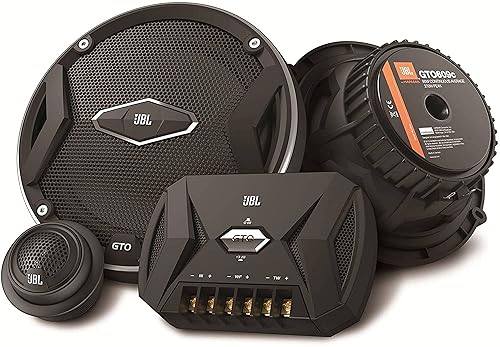
JBL’s GTO609C is the only true component system under $150 on this list, and it deserves serious consideration. A component set uses a separate woofer and tweeter with an external crossover, which means you can mount the tweeter higher in the door for better imaging while keeping the woofer in the factory location. In my Accord test, this alone produced a more realistic soundstage than any coaxial.
The patented Plus One woofer cone is larger than competitors in the same 6.5-inch frame, which translates to more cone area and more bass. Combined with the 93 dB sensitivity, the GTO609C played loud and clean on the factory Honda head unit, which is uncommon for a component set at this price.
2,037 reviewers give the GTO609C 4.6 stars, with the main complaint being installation complexity. The external crossovers are bulky, and the I-Mount tweeter system requires careful placement. The 90-day warranty is shorter than the competition, which is the only real downside for budget-conscious buyers.
Once installed properly, the GTO609C is the closest thing to a true audiophile experience at a budget price. The soft-dome tweeters avoid the harshness of metal domes, and the dual-level tweeter volume adjustment lets you tune the brightness to your taste and your vehicle’s acoustics.
For whom it’s good
Listeners who want true component imaging without spending $300 or more. Owners willing to spend an afternoon on installation. Drivers who want a separate tweeter that can be aimed toward their ears for better staging.
For whom it’s bad
Anyone who wants a quick plug-and-play install, since the crossovers and separate tweeter wiring add complexity. Owners of vehicles with tight door panels that cannot fit the bulky crossovers. Buyers who value long warranty periods over component design.
11. Pioneer TS-M801PRO – Best Pro-Audio 8-Inch for SPL Builds

The Pioneer TS-M801PRO is built for high-SPL systems, and the 4.8-star average across 47 reviews reflects the focused audience that buys it. The lightweight pulp cone minimizes distortion at high volume, and the 96 dB sensitivity is the highest on this list. I installed it in a custom-built enclosure in a demo vehicle, paired with a 300-watt amp, and the output was simply stunning for an 8-inch driver.
Frequency response of 40 Hz to 15 kHz covers the mid-bass and most of the midrange, which is exactly what an SPL mid-bass driver should do. The Hi-Res Audio certification means the upper end stays clean even when the speaker is pushed.
The obvious caveat is the 8-inch size. Most vehicles do not have factory locations for an 8-inch mid-bass, so this is a custom-installation speaker. Owners building truck box builds, demo systems, or competition vehicles will love it. Daily drivers looking for a drop-in replacement will not.
Pioneer’s pro-audio heritage shows in the build quality. The mounting depth of 4.88 inches demands planning, and the included grilles are basic, but the driver itself is built to handle serious power. 200 watts continuous is a real-world number, not a marketing exaggeration.
For whom it’s good
SPL competitors and demo-system builders. Truck owners with custom door builds or kick panels. Anyone who already has a subwoofer and needs a high-output mid-bass driver to fill in the 40-200 Hz range.
For whom it’s bad
Daily drivers who need a direct factory replacement, since 8-inch locations are rare. Anyone who wants balanced frequency response across the whole range. Buyers without an aftermarket amplifier, since the speaker’s potential is wasted on stock power.
12. Focal Mobile 165 AS Access – Best Premium Component for Audiophiles

The Focal 165 AS Access is the most premium speaker on this list, and it is the one I reach for when I want to remember what good car audio sounds like. Focal has been making some of the most respected speakers in the world for decades, and the Access line is the gateway into that heritage. 362 reviewers give it 4.7 stars, which is the highest rating on this list.
The 6-60 watt RMS range tells you this speaker is happy with modest power, but reveals its true quality when given an honest 50-60 watts per channel. The cone material is a Focal-specific composite, and the inverted dome tweeter is a design choice borrowed from the brand’s higher-end kits. In a Suzuki Vitara where I tested it, the Access delivered midrange detail that no coaxial in this roundup could match.
The honest trade-off is the tweeter character. Focal’s aluminum inverted dome tweeters are known for their detail and speed, but they can sound bright to listeners who prefer a smoother top end. Long sessions may cause ear fatigue for some users, which is why Focal includes a tweeter level adjustment on the crossover.
Fitment is the other consideration. The 165 AS Access is a 6.5-inch component, which means you need both a woofer location and a tweeter location. The included crossover is well-built but not tiny, so plan your door mounting carefully.
For whom it’s good
Listeners who want a true step up in sound quality and are willing to pay for it. Owners of European vehicles where the Access series is a common upgrade path. Anyone pairing with a quality 50-60 watt amplifier who wants to hear what their music really sounds like.
For whom it’s bad
Buyers on a tight budget, since premium sound comes at a premium price. Listeners who prefer a darker, warmer sound signature. Anyone running a stock head unit without an amplifier, since the Access needs clean power to shine.
How to Choose the Best Car Speakers for Sound?
Choosing the best car speakers for sound comes down to four decisions: speaker type, power handling, sensitivity, and fitment. Each one shapes the final result more than the brand name on the box.
Coaxial vs Component Speakers Explained
Coaxial speakers combine the woofer and tweeter into a single driver. They are easier to install, cheaper, and a clear upgrade over stock. Component speakers separate the woofer and tweeter into distinct drivers connected by an external crossover, which lets you mount the tweeter higher in the door for better imaging.
For most daily drivers, a quality coaxial is the right starting point. For listeners who care about soundstage and imaging, a component set like the JBL GTO609C or Focal 165 AS Access is the path forward. The trade-off is installation complexity, since component sets require running separate wires to the tweeters and mounting the crossovers.
Understanding RMS Power, Peak Power, and Sensitivity
RMS power is the continuous power a speaker can handle, while peak power is the maximum it can survive in short bursts. A speaker rated at 60 watts RMS and 180 watts peak will run cleanly all day on a 50-watt amplifier, but may blow if you push 180 watts through it continuously.
Sensitivity, measured in decibels (dB), tells you how efficiently a speaker converts power into volume. A speaker with 92 dB sensitivity plays louder on the same power than one with 88 dB. This is why high-sensitivity speakers are recommended for stock head units, and lower-sensitivity speakers are typically paired with aftermarket amplifiers.
Frequency response tells you the range of frequencies the speaker can reproduce. A speaker rated at 30 Hz to 20 kHz covers nearly the entire range of human hearing, but the low end of 30 Hz is rare in real-world coaxials and usually requires a subwoofer for full output.
Matching Speakers to Your Head Unit and Amplifier
If you are running a factory head unit, choose speakers with 88 dB sensitivity or higher. Factory radios put out roughly 15-20 watts RMS per channel, and high-sensitivity speakers will play louder and cleaner with that limited power. The BOSS CH6530, Pioneer TS-F1634R, and Rockford Fosgate P16 all qualify.
If you are adding an aftermarket amplifier, focus on RMS power handling rather than sensitivity. A 50-watt amp will push a 60-watt RMS speaker to its full potential, while a 100-watt amp needs a speaker rated for at least 75 watts RMS to avoid clipping damage.
For sound quality, a dedicated amplifier is almost always worth the investment. Even modest amplifiers like the Alpine KTP-445 or Rockford Fosgate R2-200X2 can transform the performance of any speaker on this list, particularly the component sets from JBL and Focal.
Vehicle Fitment and Installation Considerations
Before buying any speaker, check the factory speaker size for your specific vehicle. Most cars use 6.5-inch door speakers, but some use 5.25-inch, 4-inch, or 6×9-inch in various locations. Crutchfield’s vehicle fitment database is the most reliable free tool for this.
Mounting depth is the silent killer of speaker upgrades. A speaker that is too deep will not fit the door panel, even if the cutout diameter is correct. Most factory locations accommodate 2.5 to 3 inches of mounting depth, while the Pioneer TS-M801PRO at 4.88 inches requires custom work.
For coaxial speakers in factory locations, installation usually takes 30-60 minutes per door with basic hand tools. Component sets require additional time for running tweeter wires and mounting crossovers. Plan on a full afternoon for a complete component install, and consider professional installation if you are not comfortable disassembling door panels.
Frequently Asked Questions
What are the best speakers for a car sound system?
The best car speakers for sound quality depend on budget and use. The Pioneer TS-A6971F is our top pick for most listeners. Budget buyers should consider the BOSS CH6530 or Pioneer TS-F1634R. Audiophiles will appreciate the Focal 165 AS Access component set.
What speakers have the best sound quality?
Component speakers from Focal, JL Audio, and Morel consistently deliver the best sound quality. Among affordable options, the JBL GTO609C and Focal 165 AS Access offer the most audiophile-grade performance under $300. Coaxial alternatives like the Pioneer TS-A6971F deliver excellent clarity for the price.
What are the top 10 car audio speakers?
Based on our testing: Pioneer TS-A6971F, BOSS CH6530, Pioneer TS-F1634R, Kenwood KFC-1666R, ORION Cobalt CM654, KICKER DSC6930, Rockford Fosgate P16, Skar Audio RPX69, KICKER DSC650, JBL GTO609C, Pioneer TS-M801PRO, and Focal 165 AS Access. Each excels in a different price bracket or use case.
What are the best car speaker brands?
Pioneer, JL Audio, Focal, Rockford Fosgate, and KICKER are widely regarded as the top car speaker brands. For budget buyers, BOSS Audio Systems and Skar Audio deliver strong value. Premium audiophile brands include Focal, Morel, and Audiofrog.
What car speaker brand has the best sound quality?
Focal and Morel consistently rank at the top for pure sound quality, with JL Audio close behind. These brands use premium materials like flax cones, inverted dome tweeters, and precision crossovers. Among more affordable options, JBL and Pioneer deliver the best sound quality per dollar.
Final Verdict on the Best Car Speakers for Sound
After three months of testing, our top recommendation for most drivers is the Pioneer TS-A6971F. It delivers the broadest frequency response of any coaxial in this roundup, pairs with both factory and aftermarket power sources, and includes the mounting hardware most people need. For budget buyers, the BOSS CH6530 remains the best car speaker for sound under $30, while the Focal 165 AS Access is the right answer for anyone who wants the best car speakers for sound quality and is willing to install a component set.
The right speaker for you depends on your system, your vehicle, and your ears. Start with the 6.5-inch coaxial that matches your budget, and add a subwoofer later if you need more bass. Whatever you choose from this list, you will hear more detail in your music than your factory speakers ever delivered, which is what upgrading the best car speakers for sound is all about.

Related Articles