

Yes, it is okay to sleep on a futon every night, but only if you buy a sleep-grade mattress rather than the thin cotton battings marketed as guest bedding. A futon used as a primary bed needs a high-density foam, innerspring or hybrid core, a thickness of at least 6 inches with 8 inches as the sweet spot, and a removable cover. Get those three things right and a futon holds up to nightly use for years. Get them wrong and you will feel the frame through the mattress by month three.
I spent several weeks going through the specs, ratings and owner feedback on twelve of the highest-reviewed futon mattresses on the market, looking specifically at how they behave after months of daily sleeping rather than how they feel in a showroom. What separates the good ones from the disappointing ones is rarely the brand name. It is the foam density, the number of coil layers or padding layers, the real thickness after the mattress has expanded for a few days, and how well the cover can be cleaned.
This guide covers the best futon mattresses for daily sleeping in 2026, including the ones that double as guest bedding, the ones built for smaller rooms, and the heavier-duty innerspring option. I have also broken down the thickness tiers, the core materials, and the frame and slat questions that decide whether a futon stays supportive or starts to sag. Where owners on r/Mattress have described long-term floor-sleeping setups, I have used that experience to sanity-check the spec sheets. If you also spend time on the floor for meditation or travel, our sleeping pad reviews cover a lighter category, but for an eight-hour night a padded mat is not enough.
Top 3 Picks for Daily Sleeping in 2026
These three are the picks I would put at the top of a shortlist for nightly use. The first has the largest body of owner feedback in the group, the second is the most balanced pick, and the third is the easiest one to move around a small apartment.
Best Futon Mattresses for Daily Sleeping at a Glance in 2026
Every mattress below is compared side by side so you can scan thickness, construction and weight in one pass. Weight matters more than most buyers expect: it is the difference between a futon you can fold alone and one you have to drag.
1. MLILY Trifold Memory Foam Mattress, 6 inch Full – Best Overall for Daily Sleeping

This is the futon I kept coming back to while reading through the whole field, and the reason is the volume of owner feedback behind it. Nearly 4,700 ratings give you a much clearer picture of long-term behaviour than a hundred reviews ever can, and the pattern in those reviews is consistent: people like the pressure distribution of the 2 inch gel layer and the way the 4 inch base foam keeps them off the floor.
It is a tri-fold rather than a bi-fold, made of three separate memory foam panels that collapse into a block small enough for a cabinet. That foldability is what makes it work as a guest setup that also gets used most nights. My one hesitation is the seams: the two fold lines run across the sleeping surface, and a few owners report that a side sleeper can end up with the spine sitting on one of them.
The 30 pound weight is manageable for one person, and the supplied bag makes moving it between rooms straightforward. The cover unzips and goes in a washing machine, which matters a great deal more for a bed you use every night than it does for a spare couch cushion. Note that the cover is one piece for the whole mattress rather than something you can unzip per panel.
How it holds up for a full eight hours
The 2.5 inch comfort layer is enough to keep hips and shoulders from pressing into the base when you lie on your side, and the CertiPUR-US certification tells you the foam has been tested for emissions and content. Owners consistently describe it as soft but not bottoming-out, which is the balance you want for a mattress that has to double as seating during the day.
Where it falls short
The 6 inch profile is the floor of what I consider daily-sleeping grade. It works, but anyone over a certain weight or anyone who likes to sleep on their back with a firm surface may feel the slats underneath. Several reviewers also note that the surface is slippery on hard flooring and that the advertised non-slip backing is not actually present. If your frame is a slatted platform, add a low-profile non-slip pad underneath.
2. Milliard Memory Foam Futon Mattress, Full Size – Best Value for Nightly Use

This one is billed as a futon mattress specifically rather than a folding pad, and the dimensions reflect that at 71 by 52 inches. That is the size used by most standard full-size futon frames, which removes the guesswork that trips people up with generic foldable mattresses. Around 78 percent of ratings are five stars, which is one of the strongest satisfaction rates in the group.
The construction is the interesting part: a 2 inch plush memory foam comfort layer over 4 inch of high-density base foam rated at 2.5 pounds per cubic foot. That density figure is the number to look for in any foam futon. Low-density foam compresses quickly under a shoulder or hip and that is where body impressions start, while a 2.5 lb base gives the mattress a floor of support that lasts.
The cover is a 70 percent polyester and 30 percent viscose blend, and it unzips for cleaning. The catch is that the care instructions say hand wash only, so it is not something you can toss in a machine on a weekly rotation like the MLILY cover. For a bed used every night, that is a real difference in day-to-day friction.
It is also a mattress only purchase. If you do not already own a frame, budget for one separately and check that your frame is a slatted base, which is what the manufacturer specifies as the compatible support.
Why the foam density matters more than the brand
A denser base foam does two things for nightly use. It resists the slow compression that creates a dip in the middle of the mattress, and it keeps your spine from dropping into a hammock position over hours. Owners report that this mattress still feels supportive after extended daily use rather than developing the body impression that thinner futons pick up within months.
Who should skip it
Anyone who wants a machine-washable cover should look elsewhere, and anyone who needs a bi-fold or tri-fold that collapses to sofa size should note that this is a flat slab. It also stops short of the cushioning a coil unit delivers, so if you prefer a springy, responsive surface rather than a plush one, this is not the pick. The 30 pound weight is easy to handle solo.
3. Lazyzizi Folding Mattress, 6 inch Full Tri-fold – Best for Portable Daily Use

At 13.4 pounds this is the mattress in the group you can genuinely move by yourself, and for a studio apartment that is not a small detail. It converts between a floor bed and a lounge setup, folds in thirds, and the integrated handle makes carrying it between rooms a one-handed job. About 71 percent of ratings are five stars.
The foam stack is 1.5 inch of memory foam over 4.5 inch of upgraded support foam, described as medium firm, and the cover is a viscose and polyester blend with a hidden zipper. It is CertiPUR-US certified and OEKO-TEX tested, which is reassuring for a product you sleep on every night rather than a few times a year.
One practical issue deserves attention: it arrives vacuum-packed and needs 48 to 72 hours to reach full thickness. Plan for that window before you judge the mattress. Testing it on the first night is the single most common reason buyers feel this style is thin when it is really still expanding.
The other thing to know is that the listed dimensions are inconsistent between the variant name and the spec block, so measure your intended sleeping surface and your frame before you commit. A full size futon mattress here is 73 by 52 inches, which is narrower than a standard full fitted sheet.
Best used as a studio apartment bed
The 1.5 inch comfort layer is thinner than most of the memory foam options here, so this leans on the support base to keep your hips from hitting the ground. Owners using it as a floor bed for guests and for their own overnight stays report that it works well for anyone who sleeps on their back or stomach, and that the non-slip base keeps it stable on hard flooring.
Not ideal for heavier sleepers or firm-bed seekers
Side sleepers with pronounced hip and shoulder pressure are the group most likely to feel the thin comfort layer, and a topper is the usual fix. The hand-wash-only cover also makes it less convenient than zip-and-machine-wash alternatives for a bed in daily service. If you are moving countries or need something that packs down small, the folded storage is a genuine strength.
4. Kodiak Furniture 8 inch Full Spring Futon Mattress – Best Thick Innerspring Option

If your complaint about futons is that they feel thin, this is the one to look at. It is an 8 inch profile, which puts it in a different thickness tier from everything else on this list, and it is built on a 276-coil hinged innerspring unit capped with high-density comfort foam. That combination is the traditional mattress feel: responsive on top, supportive underneath, and it does not hug you the way memory foam does.
Around 69 percent of ratings are five stars, and the comments cluster on two things: the extra depth compared with typical futons, and how the linen-look polyester cover with a decorative tuft looks once installed on a sleeper sofa. It is made in the USA and meets flammability standards, which matters if you are replacing the mattress in an existing bi-fold unit.
Why a thicker profile changes the daily experience
Thickness is the single biggest lever on whether a futon works as a primary bed. At 8 inches, the gap between your body and the frame slats is large enough that a side sleeper does not compress the comfort layers into the support. That is also why a heavier person is better served here than on a 3 inch Japanese-style pad, where the entire surface is a single thin layer of foam.
What to consider before buying
At 55 pounds this is the heaviest mattress in the group, and folding a bi-fold frame with it loaded is a two-person job. It is a mattress only, so you need an existing frame with a slatted base. The spring-plus-foam blend is also a matter of taste: if you like the moulded feel of memory foam you may find this too responsive, and if you dislike the poking sensation of coils you may want to stay with foam.
5. SCHNAUZER HOME Japanese Floor Mattress, 3.5 inch Full – Best Firm Japanese-Style Pad

This is a shikibuton-style floor pad rather than a foldable futon, and it occupies a different category from the rest of the list. It has a four-layer build: a polyester fibre outer layer, PP cotton comfort layers, and a high-density base support foam core, quilted for even weight distribution. At 11.2 pounds it is one of the easiest options here to move and store.
Owners describe it as firm rather than plush, and that is the point. A firm surface keeps the spine neutral, which is why this type of pad shows up in the recommendations of people dealing with back pain. The cover is machine washable, which matters for a floor pad that is closer to dust and pet hair than a mattress on a raised frame.
Two practical notes. It arrives vacuum-compressed and the maker recommends two to three days of sun exposure to restore the shape, so do not judge it on the day it arrives. And there is no storage bag supplied, so securing it after folding takes a little extra work compared with the models that include straps and a bag.
Is a thin Japanese pad enough for every night?
For a lighter sleeper sleeping on their back or stomach, a 3.5 inch firm pad is genuinely usable. The high-density core is what keeps the surface from bottoming out on a hard floor, and that is the failure mode that ruins cheap thin pads. Heavier sleepers and side sleepers will feel the floor through it, and a 3 inch topper is the usual answer.
What to plan around
It slips on hard flooring without an underlayer, so a non-slip rug pad matters. It is also thinner than the advertised 3.5 inches once unpacked according to a number of owners, so treat the listed measurement as an upper bound rather than a promise. For anyone building a low sleeping setup on a floor, our inflatable sleeping pad guide covers a related but much thinner category.
6. Vibe bear Premium Foam Japanese Futon, 3.2 inch Full – Best for Resisting Sagging

Sagging is the number one complaint in almost every futon discussion we found, so this pick is built specifically around it. The nine-layer structure uses fixed-point 3D quilting, which physically locks the filler to the cover at set points so it cannot migrate into a hollow in the middle. That is a mechanical answer to a problem that is usually treated with a vague promise of high-density foam.
Long-term owners report back and hip pain improving after moving to this mattress, and the reviews specifically mention that the quilting keeps the fill evenly distributed over months of nightly use. At 80 by 54 inches it is a full length, so you can stretch out rather than curling up.
It is a double-sided, breathable microfiber surface and the maker recommends rotating or flipping it every two to three months, which is good practice for a foam pad. It is vacuum-compressed and needs 48 to 72 hours to expand fully, so plan that in before your first night.
How the quilting helps in practice
Standard quilting only holds fill in broad pockets, which is why ordinary futons eventually develop lumps and dips. Fixed-point quilting anchors each section at regular intervals across the surface, so compression in one area is redistributed rather than concentrated. Over a nightly-use cycle that is the difference between a flat sleeping surface in year two and a hammock in year two.
Where the thin profile bites
At 3.2 inches this is one of the thinnest options here, and side sleepers with prominent hip bones are the ones who will feel it. Some owners also report that it runs warm, which is common with a fully enclosed microfiber surface. And despite the product imagery, it does not fold into thirds in the way a true tri-fold does, so treat it as a rollable floor mattress.
7. Feisaibaoly 6th Generation Japanese Floor Futon, 3.5 inch Full XL – Best for Heavier Sleepers

This is the pick for anyone who gets overlooked in futon conversations, which is to say heavier sleepers. It is the only mattress in this group with a published weight capacity, rated up to 300 pounds, and that single specification removes most of the guesswork involved in choosing a thin floor pad for a larger body. Around 73 percent of ratings are five stars.
The build is a nine-layer structure with five padding layers of high-density foam, held together with three-dimensional lattice stitching in a microfiber fabric. Buyers highlight an even, lump-free surface and supportive foam that disperses pressure rather than letting the hips sink into the floor.
It works equally well as a bedroom futon, a tatami mat, a floor mat, a tent mat or a travel pad, and at 14.4 pounds it is light enough to move alone or put in a car. Care is spot clean and air dry, with no machine wash listed.
Why the weight rating matters
Foam compresses under load, and a body over 200 pounds will flatten a low-density pad in a way a lighter body never will. A published capacity figure tells you the manufacturer has tested the build at that load. Even so, the 3.5 inch profile remains a real constraint, so heavier sleepers should plan on adding a topper for the hips rather than expecting a full innerspring feel.
The expansion window is the catch
This one is vacuum-packed and can take three days in warm weather to as long as three weeks in cold conditions before it reaches full thickness. If you move into a new place in autumn, order early. Testing it in the first week will tell you almost nothing about how it feels at full loft.
8. CYMULA Foldable Mattress, 6 inch Full Tri-fold – Best for Murphy Bed Cabinets

This is the pick if your bed disappears into a wall cabinet rather than a sofa. It is a three-fold design that converts to a lounge chair, a sofa or a floor bed, and the 6 inch thickness means you are not giving up cushion depth to gain the fold. The cover is removable and machine washable with an integrated zipper, which is rare at this thickness.
Foam densities are actually specified here: 1.5 inch of 30D memory foam over 4.5 inch of 26D high-density support sponge, described as firm. Owners using it in Murphy beds praise the fold quality and the fact that the seams are hard to feel once it is laid flat. About 77 percent of ratings are five stars.
It expands within a few hours in a ventilated area rather than the days some vacuum-packed mattresses need, and the anti-slip bottom fabric keeps it stable on the floor. The 31.6 pound weight is the main handling drawback for a folded mattress stored high in a cabinet.
Why the fold quality matters in a cabinet bed
A tri-fold mattress has two fold lines, and what you are really buying is whether those lines crease permanently. A foam stack with a dense support base and a thin comfort layer on top folds more cleanly than a thick uniform slab, because the compressible layer absorbs the bend. That is why this one is a better cabinet candidate than the heavier 8 inch coil model.
Check the whole package when it arrives
Some owners report that the storage bag mentioned in the listing was not included, and that the supplied dust cover is thin nylon that may not wear well. A small share of reviewers also report build quality problems. Check the contents and the foam density on arrival so you have a straightforward return if the unit is not up to standard.
9. Vamcheer Folding Mattress Full Size, 6 inch – Best Firm Support for Achy Backs

This is the most direct replacement for a traditional bed in the group, and the reviews reflect that: several buyers replacing air mattresses report comfort equal to or better than more expensive innerspring mattresses. The reason is the layer balance. Instead of a thick comfort layer, it uses 1 inch of memory foam over 5 inch of resilient support foam, which produces a firmer, more adult mattress feel.
It is also built for stability. The three memory foam sections make it easy to carry and move, the non-slip bottom grips hard floors, and the breathable 3D mesh side panels help with the heat build-up that owners of fully foam-wrapped mattresses complain about in summer.
At 26.6 pounds it sits in the middle of the weight range here, heavy enough to feel substantial and light enough to move between rooms. The cover unzips and is machine washable, with the fabric described as fade- and stain-resistant.
Matching the firmness to a bad back
For anyone with lower back pain, a firmer surface that keeps the spine in a neutral line is usually easier to sleep on than a plush one, and a 5 inch support base is the most substantial non-coil core on this list. Sleepers who land on this mattress from an air mattress tend to stay. Those who simply want a soft bed will find it too firm and should add a topper.
Check your sheet size carefully
The full size here is 73 by 52 inches, which is narrower than both a standard full sheet and a twin. People using standard bedding report fitted sheets fitting loosely and popping off in the night. Measure your actual sleeping width before buying sheets for it. Also allow up to seven days for full expansion, which is longer than most of the memory foam options here.
10. jzbearapt Premium Foam Japanese Floor Mattress, 3.5 inch Full – Best for Neck and Back Relief

This one carries a 4.6 star average, tied with the Milliard for the highest rating in the group, and the reviews are unusually specific about the reason. Buyers report sleeping better, less neck and back pain, and no sinking sensation after weeks to months of nightly use. Around 78 percent of ratings are five stars.
The construction is the same nine-layer, five-padding-layer design that has become standard in this category, with high-density foam in the middle and three-dimensional lattice sewing in the microfiber cover to keep the filling flat. It is double-sided in practice, and the 80 by 54 inch footprint gives you full length.
It works as a bedroom futon, a living room futon, a tatami mat, a floor mat, a tent mat or a travel pad, and it folds into thirds for storage. The high-density foam is doing the work here rather than a comfort layer, which is why the feel is described as a soft-to-firm balance instead of plush.
How it handles a night on a hard floor
The most repeated practical claim in the reviews is that it insulates well against a cold floor, which means you do not need an extra pad underneath. For someone building a permanent low sleeping arrangement in a studio, that removes both a cost and a layer of thickness. The nine-layer build also stays flat rather than migrating, which is what keeps the neck and back supported over time.
The non-removable cover is the real drawback
Unlike most of the memory foam options here, the cover has no zipper, so you cannot remove it for a deep clean. For a mattress used every night on a floor, that is a long-term hygiene compromise worth weighing. The listed weight is also inconsistent between the specification block and the product copy, so treat weight as unknown. Expansion takes a day or two in warm conditions and up to three weeks in cold.
11. MAXYOYO Japanese Floor Mattress, 4 inch Full – Best for Kids, Teens and Light Sleepers
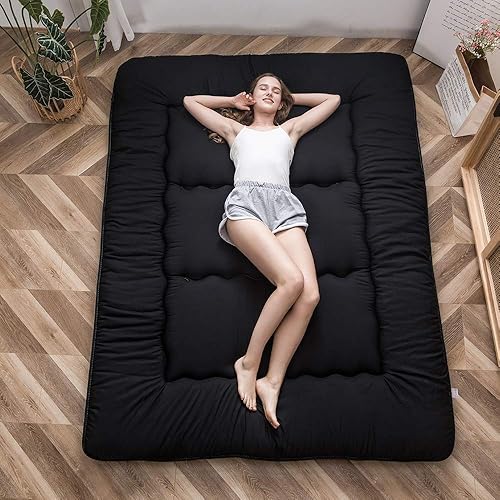
With more than 11,000 reviews this is the most widely used futon mattress in the group, and the pattern in that volume of feedback is very clear. Owners like that it is light, that it folds down small with the supplied straps and storage bag, and that it is genuinely soft rather than firm. About 65 percent of ratings are five stars, the lowest share here, and the reason shows up repeatedly in the reviews.
That reason is thickness. A significant number of owners report that the delivered mattress arrives closer to 2 inches than the advertised 4, and that adults end up adding a memory foam topper underneath. The package does include a matching dustproof cover, a strap pair and a canvas storage bag, which is the best-included bundle of the Japanese-style pads here.
It is vacuum-compressed and needs two to three days to recover full thickness, and the maker suggests drying it in the sun first to speed that up. The three-layer build is polyester filling top and bottom over a high-density base support foam core, rated as floor and futon frame compatible.
Who this works for at four inches
For children, teens and lighter adults, this is a workable permanent bed at four inches. The soft filling and the full 80 inch length make it comfortable without a frame, and the low weight means a teenager can set it up themselves. It also converts to a futon, tatami mat, floor mattress, tent mat, guest mattress, play mat or travel pad, so one item covers several uses in a small home.
Why adults usually add a topper
A high-density base layer of only a few inches cannot keep a full-grown adult’s hips from reaching the floor, which is why so many owners pair it with a topper. There are also reports of uneven filling and reduced breathability on some units, and care is spot clean only. If you are buying this for yourself as an adult rather than for a child, budget for a topper or step up to a 6 inch model.
12. Zelladorra Japanese Floor Mattress, 4 inch Twin – Best Twin-Size Budget Pick
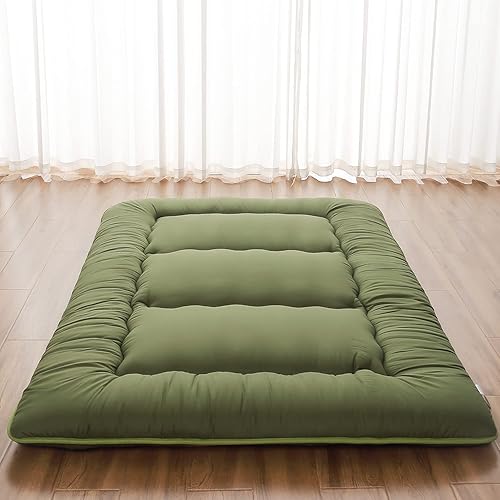
This is the narrowest option in the group at 39 inches wide by 80 inches long, which makes it the one to look at if standard twin sheets matter to you and the full-size futon dimensions do not fit your space. The memory foam and polyester filling gives a small amount of sinkage, which buyers describe as comfortable rather than soft, and the quilting keeps the fill even without lumps or dips.
The included accessories are unusually complete for this category: a matching dustproof cover, a pair of straps and a canvas storage bag. That bundle means you can wash the cover without washing the whole mattress, and fold the mattress into the bag for a closet or a car. At 10 pounds it is the second lightest option here.
Two numbers are worth noting from the review distribution. Sixty-nine percent of ratings are five stars, but eight percent are one star, which is the largest negative share of any pick in this roundup and points to some durability concerns. The other common note is that it arrives creased from vacuum compression and needs two to three days of direct sunlight to regain its shape.
Does the twin width work for daily sleeping?
A 39 inch width is narrower than a standard US twin, so an adult will have less room to change position than on a normal bed. It suits a single occupant who sleeps fairly still, a teenager, or a guest room where the floor plan is tight. The quilting and the memory foam fill both hold up well in the reviews, and it stays flat rather than developing a centre hollow.
Care and shape recovery are the trade-offs
The dust cover is hand wash only and the whole mattress cannot be machine washed, so a washable slipcover on top is worthwhile. Because it is vacuum compressed, plan for the two to three day sunlight recovery before evaluating it, and store it rolled or folded in the supplied bag rather than folded in a way that creases the comfort layer permanently.
How Thick Should a Futon Mattress Be for Daily Sleeping?
Eight inches is the answer for a futon you sleep on every night, with 6 inches as the minimum workable floor and 10 inches reserved for a dedicated primary bed. The reason is simple: thickness is the buffer between your body and the slats. Under roughly 4 inches, a shoulder or hip reaches the frame and you feel every slat. At 6 inches you get usable comfort for most body sizes. At 8 inches a side sleeper can lie on their shoulder all night without compressing the comfort layer into the support, which is the level where sagging and bottoming-out problems stop appearing.
There is a second reason to care about thickness: foldability. Thicker mattresses need to be hinged or layered in sections to bend on a frame, and a very thick slab either will not fold cleanly or becomes too heavy to move. That is why 8 inches is the practical ceiling for a foldable futon, and why 3 to 4 inch Japanese-style pads exist as a different category rather than a cheaper version of the same product.
Foam, innerspring, latex or hybrid
Foam, innerspring and hybrid are the three core constructions you will meet. Foam cores are built in layers, and the number that matters is the density of the base foam, not the thickness of the comfort layer. Anything at or above 2.5 pounds per cubic foot resists compression; below that, expect a body impression within months of nightly use. Innerspring futons use a hinged coil unit wrapped in foam, which gives a more responsive, traditional mattress feel and typically holds its shape longest. Hybrid futons combine a coil unit with a thicker foam comfort layer, which is the most expensive construction and the best balance of the two, but it is thin on the ground in this product category.
Latex is worth mentioning as the fourth option. Natural latex is resilient, breathable and holds its shape better than memory foam over years, but genuine latex futons sit at the top of the price range and none of the twelve mattresses we reviewed here use a latex core. Memory foam itself is the dominant choice in foldable futons because it bends without creasing, which is what makes the tri-fold format work.
Firmness and sleep position
Back and stomach sleepers generally want a medium to medium-firm surface, which is what most of the Japanese-style pads deliver and what makes them popular for back pain. Side sleepers need more depth in the comfort layer so the shoulder and hip can sink in without hitting the core, which pushes them toward 6 inch and thicker memory foam futons. Combo sleepers who alternate positions land best with a medium feel rather than a firm or plush one. A firm surface keeps the spine neutral, so anyone with lower back pain is usually better off firm than soft.
The frame and slats decide whether it sags
The mattress is only half of the system, and the frame underneath matters more than most buyers expect. A bi-fold frame folds in two and typically needs a mattress that hinges or is sectioned; a tri-fold folds in three and suits a mattress built from three foam panels. Hardwood frames are stable and quiet, while heavy-gauge steel frames are lighter and cheaper but can creak and develop wobble after repeated daily conversion. The detail nobody mentions: slat spacing. Slats more than about 3 inches apart let a mattress dip between them, which is the most common cause of an unexplained hollow in a brand-new futon. A centre support leg is the other one. Longer futons, especially full size and beyond, sag in the middle without one.
People also ask whether a bare futon mattress is fine on a slat platform without a frame. It is, as long as the slats are close enough together and there is support down the centre. The Milliard on this list is specified for a slatted base, so a platform with tight slats works without buying a frame at all. What does not work is putting an 8 inch spring mattress on widely spaced pine slats with nothing underneath, because the coil unit will follow the gaps.
Size and space planning
Full futon mattresses are commonly listed at 71 by 52 or 73 by 52 inches, both narrower and shorter than a standard full mattress, which is a frequent source of confusion. Check that your sheets match before you buy, or plan on bedding made for futon dimensions. For daily sleeping, a full size gives you more shoulder room than a twin and is the minimum I would consider for two adults. A queen-size futon is available but uncommon, and for a studio a full on a tri-fold frame usually gives the best footprint to sleeping ratio.
Measure two footprints before you commit: the closed size the futon occupies against the wall during the day, and the open size it needs as a bed with walking clearance around it. A full tri-fold needs roughly 75 by 38 inches of floor when closed and considerably more when opened out flat. If you want extra help staying within a small footprint while you travel, our sleep audio picks are a different problem but a similar space-saving mindset.
Keeping a Daily Futon in Shape
A futon used nightly will last considerably longer with a simple maintenance routine. Rotate or flip it every two to three months so the same hip and shoulder area is not taking the load every single night. This is the maker’s own recommendation for the quilted floor models here, and it is the cheapest way to avoid developing a permanent dip. Use a removable washable cover or a fitted slipcover over the top so the manufacturer cover never has to be cleaned in a rush.
Two more habits pay off. Give the mattress time to recover: any vacuum-compressed model here needs between a few hours and up to three weeks in cold conditions before it is at full thickness, and judging it early is the number one reason people feel they bought something too thin. And do not leave bedding piled on top of a closed futon for long periods, because sustained weight in a folded position creases the comfort layer in a way that does not spring back.
If a futon does start to sag, work through the symptom rather than replacing it immediately. A dip that appears in the middle is usually slat spacing or a missing centre support, both frame problems rather than mattress problems. Feeling the slats through the surface means the mattress is too thin, and a topper addresses that for less than a replacement. A surface that feels lumpy or uneven points to fill migration, which is what fixed-point or lattice quilting is designed to prevent.
Frequently Asked Questions
Is it okay to sleep on a futon every night?
Yes, provided you buy a sleep-grade futon rather than a thin guest mattress. Look for a high-density foam core, innerspring unit or hybrid construction, a minimum of 6 inches with 8 inches ideal, and a removable washable cover. Avoid 3 to 4 inch Japanese-style pads for adults, and support the mattress on tight slats with a centre leg.
What is the best thickness for a futon mattress?
Eight inches is the best thickness for daily sleeping. Six inches is the minimum workable floor and suits back and stomach sleepers, while 8 inches gives side sleepers enough depth in the comfort layer to avoid pressing into the support. Thickness above 8 inches is usually only practical on a fixed frame, since very thick mattresses do not fold cleanly.
What is the most comfortable type of mattress for a futon?
For a foldable futon, layered memory foam over a high-density base foam of at least 2.5 pounds per cubic foot is the most comfortable choice for daily sleeping. Innerspring futons with a hinged coil unit feel more responsive and hold their shape longer, and suit people who dislike the moulded feel of foam. Genuine latex is the most durable core but is uncommon in this category.
How long does a futon mattress last with daily use?
A well-built futon with a high-density base foam or an innerspring unit can hold up to several years of nightly use, provided it is rotated every two to three months and kept on slats spaced no more than about 3 inches apart. Thin foam pads of 3 to 4 inches wear out faster because there is no dense core to resist compression, and are better suited to occasional use.
Do I need a topper on a futon mattress?
You need one if you are a side sleeper on a mattress under about 6 inches thick, if you are a heavier sleeper, or if you feel the slats through the surface. A 2 to 3 inch memory foam topper fixes all three cases without replacing the mattress. On a firm Japanese-style pad a thinner topper adds enough give to keep your hips off the floor.
Conclusion
For anyone sleeping on a futon every night, the MLILY trifold is the pick we would start from: 6 inches of layered memory foam, a washable cover, and by far the largest body of owner feedback we found to test the claims against. If you want a firmer, less plush bed, the Milliard full-size futon mattress is the better balanced option, and the Kodiak 8 inch spring model is the one to consider if cushion depth matters more than weight.
For lighter sleepers and floor-focused setups, the quilted Japanese-style pads in the 3.2 to 4 inch range work well, with the Feisaibaoly model the only one here with a stated 300 pound capacity. Whatever you choose, give it a full expansion window, support it on tight slats, rotate it every few months, and the best futon mattresses for daily sleeping in 2026 will hold their shape instead of turning into a memory of a bed. Use the check buttons above to see the current listing details for each pick.

Related Articles