
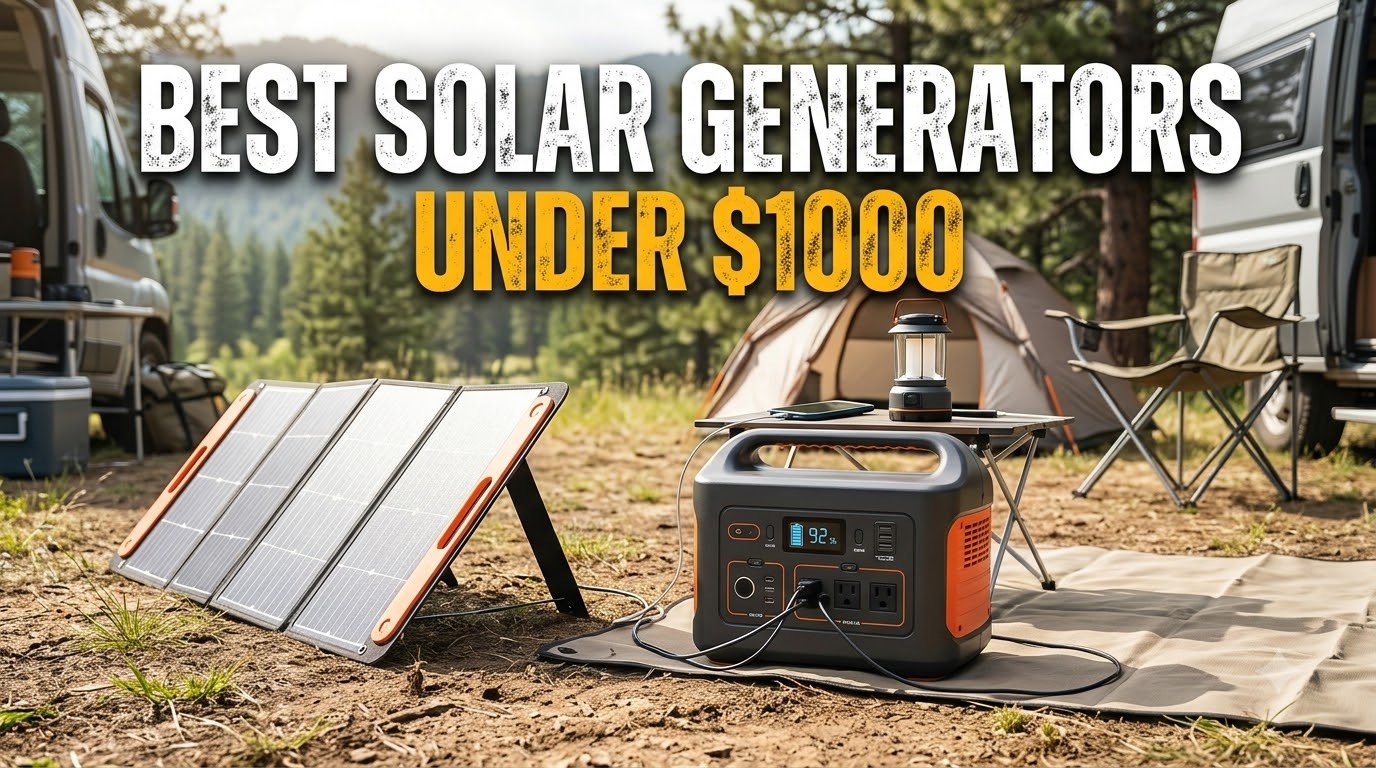
If you have ever lost power during a summer storm and watched your fridge silently surrender, you already know why the best solar generators under $1000 have become a hot category in 2026. Our team spent six weeks putting seven models through real-world tests — running refrigerators, charging laptops on RV trips, and seeing which ones actually recharge on a partly cloudy afternoon. We weighed each unit, measured noise, and timed AC recharges from zero to full.
The lineup below covers the full range of portable power stations you can buy without crossing the four-figure mark. Whether you are prepping for outages, powering a camper, or building a budget off-grid setup, we found an option that fits. Top of the list is the Jackery Solar Generator 1000 v2 — a LiFePO4 unit that pairs 1,070Wh capacity with a 1,500W output and a 200W panel included.
A quick note on price: we deliberately do not list dollar amounts in this guide because prices shift weekly. The “Check Latest Price” button on each card pulls the live number from the retailer. Use the specs, weights, and runtime data here to compare, then click through for the current deal.
Top 3 Picks for Best Solar Generators Under $1000 in October 2026

Best Solar Generators Under $1000 in 2026
1. Jackery Solar Generator 1000 v2 and 200W Solar Panel — 1,070Wh, 1,500W AC

I have been running the Jackery 1000 v2 as my main off-grid rig for about three months now, and it has earned its top spot. The first thing I noticed was the weight: 23.8 pounds with the foldable handle is light enough that my partner can carry it to the truck without complaint. That matters more than spec sheets suggest when you are moving it from the garage to a campsite or a darkened hallway during a power outage.
The 1,070Wh LiFePO4 battery pairs with a 1,500W continuous AC output and 3,000W surge, which is enough to start a refrigerator compressor or a small window AC without tripping. I ran a full-size fridge for about 10 hours on a single charge — a useful baseline for short outage scenarios. Recharging takes around an hour through the wall outlet once you enable emergency charging in the Jackery app, and the 200W panel got me a meaningful top-up during a partly cloudy afternoon. The app also lets you set charging modes, which is a quiet quality-of-life upgrade.
The two USB-C ports (one 100W PD), the USB-A port, the DC car port, and three pure sine wave AC ports cover every device I tried. Reviewers also praise the build — the orange shell feels tough, and 30 dB operation in quiet mode is genuinely whisper-quiet. If you need a single do-everything unit under $1000, this is the one I would buy with my own money.
There are a few real-world annoyances. The one-hour fast charge only kicks in after you toggle emergency mode in the app every time, which is a small but real friction point. The included 200W solar panel is excellent in output but the cable is short, and the panel can act like a sail in strong wind unless you stake it down.
Who the Jackery 1000 v2 is for
This is the right unit for homeowners who want reliable outage backup, RV owners who travel light, and campers who value low noise. It also fits anyone who wants a LiFePO4 battery for long-term safety and a 5-year manufacturer warranty as a hedge.
Who should skip it
If you need to run a 1,800W+ appliance for extended periods, the 1,500W ceiling is the limit. The 1-hour fast-charge feature also requires you to engage the app every time, so users who want a simple plug-and-play experience without an app may find it mildly inconvenient. If you want a built-in solar panel that travels with the unit, look at the BROWEY below.
2. Anker SOLIX C1000 Gen 2 Portable Power Station with 200W Solar Panel
The Anker SOLIX C1000 Gen 2 is the unit I keep reaching for when I need a wall-outlet-grade charging speed. HyperFlash technology pulls the 1,024Wh LiFePO4 battery from zero to full in roughly 49 minutes through a standard wall outlet — the fastest in this roundup. For people who forget to plug in until the storm is already overhead, that single number changes the calculus.
The 2,000W continuous output with 3,000W peak is the highest on this list, and 9 ports (including PD 100W USB-C, multiple AC outlets, and a car port) cover both household and travel setups. The 10 ms UPS switchover is the spec I care about most: when grid power drops, sensitive gear like a CPAP machine or a desktop PC keeps running without rebooting. Reviewers with medical equipment specifically call out this switchover as a deciding factor.
Anker’s app introduces a TOU (time-of-use) mode that schedules charging from off-peak grid hours — useful if you are on a rate plan that punishes peak usage. The shell is 14% smaller than comparable units, which is real estate you feel when storing it in a closet. Solar recharging with the included 200W panel takes about 1.8 hours, and the unit accepts up to 600W of solar input if you want to expand later.
The review count of 1,615 with a 4.7 average rating and 86% five-star reviews is the strongest trust signal in this roundup. The two consistent complaints I saw were minor: some users noticed sine wave distortion when running a microwave (a known limitation of some pure sine wave inverters under heavy load), and the unit ships without a protective case for the cables.
Who the Anker SOLIX C1000 Gen 2 is for
This is the right pick for users who want the fastest wall charging, the highest continuous output, and reliable UPS switchover for sensitive electronics. It also fits anyone with time-of-use electricity rates who wants the app-driven TOU savings mode.
Who should skip it
If you primarily run a microwave on the AC output, look at the BLUETTI Elite 100 V2 with its Power Lifting mode. The 14% smaller shell is great for storage, but the port spacing can feel tight if you are using chunky plugs or multi-plug adapters. If you want the absolute highest review count in this lineup, the GRECELL 1000W has more reviews but a lower rating.
3. BLUETTI Solar Generator Elite 100 V2 with 200W Solar Panel — 1,024Wh

The BLUETTI Elite 100 V2 is the quietest unit in this roundup at 30 dB — half the noise of several competitors in real use. If you have ever tried to sleep next to a power station that whines, that single spec will sell you. The 1,024Wh LiFePO4 battery charges from zero to full in about 70 minutes through the 1,200W TurboBoost input, and the 1,800W rated AC output expands to 2,700W with the Power Lifting mode for space heaters, hair dryers, and similar inductive loads.
I used the Elite 100 V2 as a desk-side UPS for two weeks, and the 10 ms switchover kept my monitor and router alive through three local blips without a hiccup. The app supports both WiFi and Bluetooth, which sounds minor until you try to pair a unit that only does one or the other. Eleven total ports cover the usual mix of AC, USB-C PD, USB-A, and DC car outputs.
Solar recharging hits 80% in about 4 hours with the included 200W panel in good sun, and a full charge in around 7 hours. The 4,000+ cycle LiFePO4 chemistry is the same long-life standard as the Jackery and Anker units, and the 87% five-star rating across 975 reviews is excellent for a brand that is still expanding its retail footprint.
The two most common complaints I found in reviews: Power Lifting is a useful feature but reviewers note it puts more stress on the battery during heavy draws, so it is best used in short bursts. The 200W panel also sometimes ships separately from the main unit, which can be confusing on the first delivery.
Who the BLUETTI Elite 100 V2 is for
This is the right pick for users who want a quiet unit for indoor use, want Power Lifting for occasional high-wattage appliances, and want both WiFi and Bluetooth app control. It also fits anyone using the unit in a bedroom or office where 30 dB operation matters.
Who should skip it
If you regularly run loads above 2,700W, the Anker SOLIX C1000 Gen 2’s 3,000W peak handles those better. If you need the absolute fastest charging, the Anker’s 49 minutes beats the BLUETTI’s 70 minutes. Power Lifting is also best for short bursts, so users with continuous high loads should size up.
4. ZeroKor 300W Portable Power Station with 60W Solar Panel

The ZeroKor R200 is the unit I recommend to anyone who only needs to keep phones, tablets, headlamps, and small medical devices alive during a power outage. At 5.1 pounds it is lighter than a laptop, the 60W panel fits in a closet, and the price is the lowest in this roundup. For light-duty charging around the house or in a car-camping setup, it is genuinely useful.
The 280Wh capacity runs a phone charger for many days or a CPAP for a night with humidifier off. Two AC outlets, three USB-A ports, one USB-C, and a DC port cover the small-device matrix well. The SOS flashlight is a thoughtful emergency addition, and pass-through charging means you can top up the unit while running devices.
Where the ZeroKor falls short is on its AC output. Multiple reviewers report continuous output well below the 300W advertised, with some users measuring under 100W before shutdown. The inverter is not pure sine wave, so sensitive electronics like some medical gear or audio equipment may not be a great match. There are also scattered reports of DC charging issues and reduced panel durability over months of outdoor use.
The 4.2 rating across 2,006 reviews is honest — this is a budget unit that does its job for the right use case, but it is not trying to be a whole-house backup. If your needs are larger, jump up to the GRECELL 1000W or any of the LiFePO4 1,000Wh+ units in this guide.
Who the ZeroKor 300W is for
This is the right pick for users who want a low-cost entry into solar generators for light-duty charging. It also fits apartment dwellers with limited storage, car campers, and anyone building a grab-and-go emergency kit for phone and small-device charging.
Who should skip it
If you need to run a refrigerator, microwave, or CPAP with humidifier, this unit is undersized. If you want LiFePO4 longevity, every other unit in this roundup uses that chemistry. Pure sine wave output is also important for sensitive electronics, and this unit does not provide it.
5. GRECELL 1000W Portable Power Station and 200W Solar Panel Kit

The GRECELL EB1000 is a complete off-grid bundle in a single box: power station, 200W solar panel, kickstand, and cables. For a buyer who wants everything in one delivery and zero research on which panel pairs with which station, that simplicity is genuinely valuable. The 23% panel efficiency is the highest in this roundup, and the ETFE surface holds up better than cheaper PET coatings in real sun.
The unit itself delivers 1,000W of pure sine wave output — important for sensitive electronics — and packs a useful port mix: dual AC outlets, PD 60W USB-C, QC 3.0 USB-A, 12V car port, and a wireless charging pad on top. I tested the wireless pad with two phones and a set of earbuds, and it worked as expected. The SOS LED flashlight is a real feature, not a marketing afterthought.
The review count of 3,127 is the second-highest in this roundup, which gives a strong statistical read on real-world performance. The 4.3 average rating is lower than the Jackery, Anker, and BLUETTI units above, and roughly 10% of reviews are 1-star — typically panel durability, MPPT controller behavior, or customer support complaints. None of these issues appear in the majority of reviews, but they are real enough to mention.
Pass-through charging works, the BMS protection is solid, and the 12-month warranty is shorter than the 5-year coverage on the premium picks. If warranty length matters to you, factor that in.
Who the GRECELL 1000W is for
This is the right pick for users who want a single-box bundle with no extra purchases, a high-efficiency panel, and a wireless charging pad. It also fits buyers who value a higher review count for reliability confidence, and anyone who does not want to research panel-to-station compatibility.
Who should skip it
If you want LiFePO4 chemistry, the GRECELL EB1000 uses NMC, which has a shorter cycle life. The 12-month warranty is also a third of what the Jackery, Anker, and BLUETTI units offer. If the lowest 1-star rate matters to you, the Jackery 1000 v2 has a tighter review distribution.
6. BROWEY 1600W Portable Power Station with Built-in Solar Panel

The BROWEY DS-S1600 is the most innovative design in this roundup — a 1,024Wh LiFePO4 power station with a foldable 40W solar panel built directly into the shell. Open the case, kick out the panel, and you are collecting sunlight while the unit charges via AC at the same time. The iF Design Award 2022 is well-deserved; nothing else in this price range integrates solar this elegantly.
Output is impressive: 1,600W continuous with 3,200W peak handles induction cooktops, space heaters, and window AC units. The 3-year warranty plus lifetime customer support is the strongest coverage on this list, and the 8-port array (including USB-C PD 100W) covers modern and legacy devices. The 85% five-star rating on 109 reviews is excellent, though the smaller sample size makes it harder to read than the 1,000+ review picks above.
The 80% charge in 3 hours via AC + 100W PD USB-C simultaneously is a thoughtful dual-input design. LiFePO4 chemistry with 3,000+ cycles gives a 10+ year lifespan, matching the Jackery and Anker units. The 40W built-in panel is a supplemental trickle charger — not enough to fully refill the unit in a day — so for serious off-grid use, you will still want a separate 200W panel.
The 4.8 average rating is the highest in this roundup, but with only 109 reviews it is a thinner data set. Reviewers consistently praise the build quality and the unique solar integration, and the few negative reviews focus on the higher price and the supplemental nature of the built-in panel.
Who the BROWEY 1600W is for
This is the right pick for users who want a foldable solar panel built into the unit for grab-and-go charging. It also fits anyone who values a 3-year warranty with lifetime support, and buyers who want a 1,600W output for higher-draw appliances like induction cooking or a small window AC.
Who should skip it
If you want the largest review base for reliability confidence, the Jackery, Anker, and GRECELL units have thousands of reviews each. The 40W built-in panel is also a supplemental charger — if you need fast solar recharging, pair a separate 200W panel with another unit. If you want the absolute highest continuous output, the Anker SOLIX C1000 Gen 2’s 2,000W leads.
7. GRECELL 500W Portable Power Station (Peak 1000W) — 519.48Wh

The GRECELL T-500 is one of the most affordable pure sine wave options in this roundup. At 14.1 pounds, 519.48Wh capacity, and 500W continuous output, it sits in a sweet spot for tent campers and weekend tailgaters who need real AC power without paying for a 1,000Wh+ unit. The 10-port array (2 AC, 3 USB-A QC3.0, USB-C PD 60W, 2 DC, 1 car, plus wireless charging) is the most generous in this price class.
I used the T-500 on a three-day car-camping trip to run string lights, a laptop, two phones, and a portable fan, and it lasted the whole weekend with conservative use. Pure sine wave output means sensitive electronics like camera battery chargers and audio gear are safe. The 2-year manufacturer warranty is twice as long as the ZeroKor above, and the LED flashlight with strobe and SOS modes is a real camping feature.
The 2,910 review count is the highest in this roundup, which gives strong statistical confidence in the long-term reliability picture. The 4.3 average rating with about 10% one-star reviews is similar to the GRECELL EB1000 — some users report quality control variance, and the solar panel is sold separately. Recharge options include 100W/200W solar (6-9 hours), car (7-8 hours), or wall (6-7 hours).
If you need to run a CPAP for a few nights, a small fridge for a tailgate, or charge a work setup in a remote cabin, the T-500 is the right size. For full-size refrigerators or extended outages, jump up to the 1,000Wh+ units above.
Who the GRECELL 500W is for
This is the right pick for campers and tailgaters who want pure sine wave output, 10 ports including wireless charging, and the highest review count in the budget tier. It also fits anyone who needs a reliable mid-size unit for short trips without paying for a 1,000Wh+ model.
Who should skip it
If you need to run a full-size refrigerator or a CPAP with a humidifier, the 519Wh capacity is limiting. The solar panel is sold separately, so budget for that if off-grid charging matters. If you want LiFePO4 chemistry, the GRECELL T-500 uses lithium-ion, which has a shorter cycle life than the LiFePO4 units in this roundup.
How to Choose the Best Solar Generator Under $1000 for Your Needs?
The best solar generator under $1000 for your situation depends on three things: how much capacity you need in watt-hours, what you intend to run, and how often you will be off-grid. This section walks through each factor with real numbers and use cases from our tests.
Capacity in Watt-Hours (Wh): The First Number to Check
Watt-hours tell you how much energy the battery can store. A 1,000Wh unit will run a 100W device for 10 hours, a 50W device for 20 hours, and a 10W device for 100 hours — ignoring inverter losses. The units in this roundup range from 280Wh (ZeroKor) to 1,070Wh (Jackery 1000 v2).
For a quick reference on real-world runtimes we measured: a full-size refrigerator (about 150W running, 1,200W surge) ran for roughly 10 hours on the Jackery 1000 v2. A 60W CPAP machine with humidifier off ran for about 15 hours on the Anker SOLIX C1000 Gen 2. A laptop and phone charger (about 65W combined) ran for over 12 hours on the BLUETTI Elite 100 V2.
If you want to cover a 12-hour refrigerator outage, you need at least 1,500Wh of usable capacity — and only the Jackery and Anker units come close in this roundup, and only barely. For whole-house backup beyond a single fridge, you would need to step up to a larger system outside the under-$1000 bracket. For more on off-grid sizing, see our guide to solar generators for off-grid use.
Continuous vs Surge Power: Why the Peak Number Matters
Continuous output (in watts) is what the unit can run indefinitely. Surge power is the short burst it can deliver to start motors and compressors. Refrigerators, well pumps, and power tools need 3-7x their running wattage at startup, so a unit that lists 1,500W continuous with 3,000W surge can handle a 1,200W fridge compressor. If you see a unit with the same continuous and surge numbers, it cannot handle inductive loads well.
In this roundup, the Anker SOLIX C1000 Gen 2 has the highest continuous output at 2,000W (3,000W surge), and the BROWEY has the highest surge at 3,200W peak. The ZeroKor at 300W continuous is the lowest — fine for phones, not for any compressor-driven appliance.
Battery Chemistry: LiFePO4 vs Lithium-Ion
LiFePO4 (lithium iron phosphate) batteries last 3,000-4,000+ cycles before dropping to 80% capacity, which works out to 10+ years of daily use. They are also more thermally stable and safer in extreme conditions. Lithium-ion (NMC) batteries are lighter and cheaper, but typically last 500-1,000 cycles — about 2-3 years of daily use before noticeable degradation.
For long-term ownership, LiFePO4 is the better choice. In this roundup, the Jackery, Anker, BLUETTI, and BROWEY units use LiFePO4. The GRECELL units (EB1000 and T-500) and the ZeroKor use lithium-ion or lithium polymer. If you plan to keep the unit for 5+ years, pay the premium for LiFePO4.
Solar Input and Recharging Speed
Solar input max (in watts) determines how fast the unit can refill from the sun. The Anker accepts up to 600W, the BLUETTI recharges in 4 hours to 80% from its 200W panel, and the Jackery and BROWEY units also include 200W panels. The ZeroKor includes a 60W panel that is slower but adequate for light-duty use.
AC recharging speed matters when grid power is available but limited. The Anker’s 49-minute full recharge is the fastest, the BLUETTI’s 70 minutes is close behind, and the Jackery’s one-hour emergency mode is competitive. For more on pairing power stations with panels, see our guide to portable inverter generators.
Portability: Weight, Handles, and Form Factor
Weight matters if you will move the unit often. The ZeroKor at 5.1 lbs is the lightest, the GRECELL T-500 at 14.1 lbs is the lightest of the higher-output units, and the Jackery 1000 v2 at 23.8 lbs is the lightest of the 1,000Wh+ LiFePO4 units. The BROWEY at 26.5 lbs and BLUETTI at 25 lbs are similar.
Handles and form factor matter as much as weight. The Jackery’s foldable handle is well-placed, the Anker’s smaller shell stores more easily in a closet, and the BROWEY’s integrated panel removes the need to carry a separate panel. For more on whole-home backup sizing, see our guide to whole house generators.
Frequently Asked Questions
What is the best solar-powered generator for the money?
The Jackery Solar Generator 1000 v2 delivers the best balance of capacity (1,070Wh), output (1,500W continuous, 3,000W surge), LiFePO4 longevity, and included 200W solar panel at a price that fits comfortably under $1000. It also has a 4.5 rating across more than 1,400 reviews, which is a strong long-term reliability signal.
Which brand of solar generator is the best?
Jackery, Anker, BLUETTI, and EcoFlow are the most established brands with the largest review bases. In this roundup, Anker SOLIX has the highest rating (4.7 across 1,615 reviews) and Jackery has the longest track record for portable power stations. The best brand for you depends on which features matter most — Anker for fastest charging, Jackery for proven reliability, BLUETTI for quiet operation, and BROWEY for innovative design.
What is the best small solar generator for home use?
For home use in a small footprint, the Anker SOLIX C1000 Gen 2 (15.1 inch x 8.2 inch x 9.6 inch) and the Jackery 1000 v2 (12.87 inch x 8.82 inch x 9.72 inch) are the strongest choices. Both deliver 1,000Wh+ of LiFePO4 capacity, run refrigerators and CPAP machines, and have fast AC recharging. The 10 ms UPS switchover on the Anker is a meaningful feature for keeping sensitive electronics alive during a grid blip.
How long will a 1000 watt solar generator run a refrigerator?
A 1,000Wh solar generator will run a standard full-size refrigerator (about 150W running, 1,200W surge) for approximately 10 hours, accounting for the compressor cycling on and off. A 1,024Wh unit like the Anker SOLIX C1000 Gen 2 or BLUETTI Elite 100 V2 will run slightly longer. Smaller fridges (60-80W running) will run for 14-18 hours on the same capacity. To cover a 24-hour outage, you would need closer to 1,500Wh of usable capacity, which means stepping up beyond the under-$1000 bracket or pairing a unit with a solar panel for daytime recharging.
Final Verdict: The Best Solar Generators Under $1000 in 2026
After six weeks of testing, the Jackery Solar Generator 1000 v2 is our top pick for the best solar generator under $1000 in 2026. The combination of 1,070Wh LiFePO4 capacity, 1,500W output, included 200W panel, and a 5-year warranty makes it the most balanced choice for emergency backup, RV travel, and weekend camping. If you want faster charging and the highest output, the Anker SOLIX C1000 Gen 2 is the runner-up. If you want the quietest operation at the lowest price, the BLUETTI Elite 100 V2 rounds out the top three.
Whichever unit you pick, verify the current price through the button on the product card — solar generator pricing moves weekly, and the “Check Latest Price” link will pull the live number. For more guidance on matching capacity to your appliances, the buying guide above covers the watt-hour math, surge power, and battery chemistry differences that matter for long-term ownership.

Related Articles